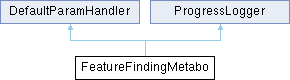
Method for the assembly of mass traces belonging to the same isotope pattern, i.e., that are compatible in retention times, mass-to-charge ratios, and isotope abundances.
More...
|
| std::vector< const Element * > | elementsFromString_ (const std::string &elements_string) const |
| | parses a string of element symbols into a vector of Elements
|
| |
| Range | getTheoreticIsotopicMassWindow_ (const std::vector< Element const * > &alphabet, int peakOffset) const |
| |
| double | computeCosineSim_ (const std::vector< double > &vec1, const std::vector< double > &vec2) const |
| | Computes the cosine similarity between two vectors.
|
| |
| int | isLegalIsotopePattern_ (const FeatureHypothesis &feat_hypo) const |
| | Compare intensities of feature hypothesis with model.
|
| |
| void | loadIsotopeModel_ (const std::string &) |
| |
| double | scoreMZ_ (const MassTrace &mt1, const MassTrace &mt2, Size isotopic_position, Size charge, Range isotope_window) const |
| | Perform mass to charge scoring of two multiple mass traces.
|
| |
| double | scoreMZByExpectedMean_ (Size iso_pos, Size charge, const double diff_mz, double mt_variances) const |
| | score isotope m/z distance based on the expected m/z distances using C13-C12 or Kenar method
|
| |
| double | scoreMZByExpectedRange_ (Size charge, const double diff_mz, double mt_variances, Range isotope_window) const |
| | score isotope m/z distance based on an expected isotope window which was calculated from a set of expected elements
|
| |
| double | scoreRT_ (const MassTrace &mt1, const MassTrace &mt2) const |
| | Perform retention time scoring of two multiple mass traces.
|
| |
| double | computeAveragineSimScore_ (const std::vector< double > &intensities, const double &molecular_weight) const |
| | Perform intensity scoring using the averagine model (for peptides only)
|
| |
| void | findLocalFeatures_ (const std::vector< const MassTrace * > &candidates, double total_intensity, std::vector< FeatureHypothesis > &output_hypotheses) const |
| | Identify groupings of mass traces based on a set of reasonable candidates.
|
| |
Method for the assembly of mass traces belonging to the same isotope pattern, i.e., that are compatible in retention times, mass-to-charge ratios, and isotope abundances.
In FeatureFindingMetabo, mass traces detected by the MassTraceDetection method and afterwards split into individual chromatographic peaks by the ElutionPeakDetection method are assembled to composite features if they are compatible with respect to RTs, m/z ratios, and isotopic intensities. To this end, feature hypotheses are formulated exhaustively based on the set of mass traces detected within a local RT and m/z region. These feature hypotheses are scored by their similarity to real metabolite isotope patterns. The score is derived from independent models for retention time shifts and m/z differences between isotopic mass traces. Hypotheses with correct or false isotopic abundances are distinguished by a SVM model. Mass traces that could not be assembled or low-intensity metabolites with only a monoisotopic mass trace to observe are left in the resulting FeatureMap as singletons with the undefined charge state of 0.
Reference: Kenar et al., doi: 10.1074/mcp.M113.031278
Parameters of this class are:
| Name | Type | Default | Restrictions | Description |
|---|
| local_rt_range |
float | 10.0 |
| RT range where to look for coeluting mass traces |
| local_im_range |
float | 0.02 |
| IM range where to look for coeluting mass traces |
| local_mz_range |
float | 6.5 |
| MZ range where to look for isotopic mass traces |
| charge_lower_bound |
int | 1 |
| Lowest charge state to consider |
| charge_upper_bound |
int | 3 |
| Highest charge state to consider |
| chrom_fwhm |
float | 5.0 |
| Expected chromatographic peak width (in seconds). |
| report_summed_ints |
string | false |
false, true | Set to true for a feature intensity summed up over all traces rather than using monoisotopic trace intensity alone. |
| enable_RT_filtering |
string | true |
false, true | Require sufficient overlap in RT while assembling mass traces. Disable for direct injection data.. |
| isotope_rt_overlap_reference |
string | longer |
longer, shorter | Reference trace the RT overlap is measured against when scoring two co-eluting mass traces (only used if 'enable_RT_filtering' is enabled): 'longer' measures the overlap against the longer trace (default, historic behavior); 'shorter' measures it against the shorter trace and additionally requires the apex of the longer trace to fall within the RT range of the shorter trace. Since low-intensity isotope traces are usually much shorter than the monoisotopic trace, 'shorter' better groups them (see issue @#4483). |
| min_isotope_rt_overlap |
float | 0.7 |
min: 0.0 max: 1.0 | Minimum fraction of the reference trace (see 'isotope_rt_overlap_reference') in RT (within FWHM) that must overlap the other trace so the two are scored as isotopes. Only used if 'enable_RT_filtering' is enabled. |
| isotope_filtering_model |
string | metabolites (5% RMS) |
metabolites (2% RMS), metabolites (5% RMS), peptides, none | Remove/score candidate assemblies based on isotope intensities. SVM isotope models for metabolites were trained with either 2% or 5% RMS error. For peptides, an averagine cosine scoring is used. Select the appropriate noise model according to the quality of measurement or MS device. |
| mz_scoring_13C |
string | false |
false, true | Use the 13C isotope peak position (~1.003355 Da) as the expected shift in m/z for isotope mass traces (highly recommended for lipidomics!). Disable for general metabolites (as described in Kenar et al. 2014, MCP.). |
| use_smoothed_intensities |
string | true |
false, true | Use LOWESS intensities instead of raw intensities. |
| report_smoothed_intensities |
string | true |
false, true | Report smoothed intensities (only if use_smoothed_intensities is true). |
| report_convex_hulls |
string | false |
false, true | Augment each reported feature with the convex hull of the underlying mass traces (increases featureXML file size considerably). |
| report_chromatograms |
string | false |
false, true | Adds Chromatogram for each reported feature (Output in mzml). |
| remove_single_traces |
string | false |
false, true | Remove unassembled traces (single traces). |
| mz_scoring_by_elements |
string | false |
false, true | Use the m/z range of the assumed elements to detect isotope peaks. A expected m/z range is computed from the isotopes of the assumed elements. If enabled, this ignores 'mz_scoring_13C' |
| elements |
string | CHNOPS |
| Elements assumes to be present in the sample (this influences isotope detection). |
Note:
- If a section name is documented, the documentation is displayed as tooltip.
- Advanced parameter names are italic.
Perform mass to charge scoring of two multiple mass traces.
Scores two mass traces based on the m/z and the hypothesis that one trace is an isotopic trace of the other one. The isotopic position (which trace it is) and the charge for the hypothesis are given as additional parameters. The scoring is described in Kenar et al., and is based on a random sample of 115 000 compounds drawn from a comprehensive set of 24 million putative sum formulas, of which the isotopic distribution was accurately calculated. Thus, a theoretical mu and sigma are calculated as:
mu = 1.000857 * j + 0.001091 u sigma = 0.0016633 j * 0.0004751
where j is the isotopic peak considered. A similarity score based on agreement with the model is then computed.
Reference: Kenar et al., doi: 10.1074/mcp.M113.031278
An alternative scoring was added which test if isotope m/z distances lie in an expected m/z window. This window is computed from a given set of elements.
- Parameters
-
| [in] | mt1 | First mass trace |
| [in] | mt2 | Second mass trace |
| [in] | isotopic_position | Isotopic position |
| [in] | charge | Charge |
| [in] | isotope_window | Isotope window |
Perform retention time scoring of two multiple mass traces.
Computes the similarity of the two peak shapes using cosine similarity (see computeCosineSim_) if some conditions are fulfilled. The RT overlap of the two peaks at FWHM must exceed the fraction given by the 'min_isotope_rt_overlap' parameter. By default ('isotope_rt_overlap_reference' = "longer") the overlap is measured against the longer trace with a threshold of 0.7 (i.e. 70 % overlap), as described in Kenar et al. When 'isotope_rt_overlap_reference' is set to "shorter", the overlap is measured against the shorter trace instead (better for low-intensity isotope traces that are much shorter than the monoisotopic trace) and, additionally, the apex (most intense peak) of the longer trace must fall within the RT range of the shorter trace.
- Note
- this only works for equally sampled mass traces, e.g. they need to come from the same map (not for SRM measurements for example).
- Parameters
-
| [in] | mt1 | First mass trace |
| [in] | mt2 | Second mass trace |

 Public Member Functions inherited from DefaultParamHandler
 1.9.8
1.9.8 