|
| void | setCutsAfterRegEx (const std::string &value) |
| | sets the "cuts after ..." regular expression
|
| |
| std::string | getCutsAfterRegEx () const |
| | returns the "cuts after ..." regular expression
|
| |
| void | setCutsBeforeRegEx (const std::string &value) |
| | sets the "cuts before ..." regular expression
|
| |
| std::string | getCutsBeforeRegEx () const |
| | returns the "cuts before ..." regular expression
|
| |
| void | setThreePrimeGain (const std::string &value) |
| | sets the 3' gain (as a nucleotide modification code)
|
| |
| std::string | getThreePrimeGain () const |
| | returns the 3' gain (as a nucleotide modification code)
|
| |
| void | setFivePrimeGain (const std::string &value) |
| | sets the 5' gain (as a nucleotide modification code)
|
| |
| std::string | getFivePrimeGain () const |
| | returns the 5' gain (as a nucleotide modification code)
|
| |
| bool | setValueFromFile (const std::string &key, const std::string &value) override |
| | Set the value of a member variable based on an entry from an input file.
|
| |
| | DigestionEnzyme (const DigestionEnzyme &)=default |
| | Copy constructor.
|
| |
| | DigestionEnzyme (DigestionEnzyme &&)=default |
| | Move constructor.
|
| |
| | DigestionEnzyme (const std::string &name, const std::string &cleavage_regex, const std::set< std::string > &synonyms=std::set< std::string >(), std::string regex_description="") |
| | Detailed constructor.
|
| |
| | DigestionEnzyme (const std::string &name, std::string cut_before, const std::string &nocut_after="", std::string sense="C", const std::set< std::string > &synonyms=std::set< std::string >(), std::string regex_description="") |
| | Detailed constructor 2.
|
| |
| virtual | ~DigestionEnzyme () |
| | Destructor.
|
| |
| DigestionEnzyme & | operator= (const DigestionEnzyme &)=default |
| | Assignment operator.
|
| |
| DigestionEnzyme & | operator= (DigestionEnzyme &&) &=default |
| | Move assignment operator.
|
| |
| void | setName (const std::string &name) |
| | sets the name of the enzyme
|
| |
| const std::string & | getName () const |
| | returns the name of the enzyme
|
| |
| void | setSynonyms (const std::set< std::string > &synonyms) |
| | sets the synonyms
|
| |
| void | addSynonym (const std::string &synonym) |
| | adds a synonym
|
| |
| const std::set< std::string > & | getSynonyms () const |
| | returns the synonyms
|
| |
| void | setRegEx (const std::string &cleavage_regex) |
| | sets the cleavage regex
|
| |
| const std::string & | getRegEx () const |
| | returns the cleavage regex
|
| |
| void | setRegExDescription (const std::string &value) |
| | sets the regex description
|
| |
| const std::string & | getRegExDescription () const |
| | returns the regex description
|
| |
| bool | operator== (const DigestionEnzyme &enzyme) const |
| | equality operator
|
| |
| bool | operator!= (const DigestionEnzyme &enzyme) const |
| | inequality operator
|
| |
| bool | operator== (const std::string &cleavage_regex) const |
| | equality operator for regex
|
| |
| bool | operator!= (const std::string &cleavage_regex) const |
| | equality operator for regex
|
| |
| bool | operator< (const DigestionEnzyme &enzyme) const |
| | order operator
|
| |
Representation of a digestion enzyme for RNA (RNase)
The cutting sites of these enzymes are defined using two different mechanisms: First, a single regular expression that is applied to strings of unmodified RNA sequence and defines cutting sites via zero-length matches (using lookahead/lookbehind assertions). This is the same mechanism that is used for proteases (
- See also
- ProteaseDigestion). However, due to the complex notation involved, this approach is not practical for modification-aware digestion. Thus, the second mechanism uses two regular expressions ("cuts after"/"cuts before"), which are applied to the short codes (e.g. "m6A") of sequential ribonucleotides. If both expressions match, then there is a cutting site between the two ribonucleotides.
There is support for terminal (5'/3') modifications that may be generated on fragments as a result of RNase cleavage. A typical example is 3'-phosphate, resulting from cleavage of the phosphate backbone.

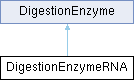
 Public Member Functions inherited from DigestionEnzyme
 1.9.8
1.9.8 